Thứ Tư, 14 tháng 1, 2015

When’s the best time to visit Hanoi?

Don’t be fooled by the fact Hanoi is in Southeast Asia and think shorts and T-shirts are good to go all year round. Hanoi has four seasons, and as the city’s in the northern hemisphere, that means the chilly winter starts in December and steaming summer hovers around July and August. It’s impossible to give firm predictions of the Hanoi weather each month, or even each season, as temperatures, rainfall and sunshine can change from day to day — and often do. But we can offer some general suggestions. Hanoi Cycling Tour

Now that’s when you want to be in Hanoi.
Let’s start with the coldest time of year. Temperatures from December to around February can drop to a cold (yes, really, it is cold) 10 degrees Celsius and reach an almost balmy 20 degrees Celsius. Ten degrees in Hanoi is a lot colder than you might expect: the humidity, wind chill factor and lack of building insulation and heating can make it feel much chillier. But that doesn’t mean it’s necessarily a bad time to come, as humidity is lower than at other times of year, rainfall is lower and skies are often bright blue — plus you might hit a 20-degree day, and that’s a great temperature for exploring the sights of the city on foot. It’s also Tet time, a pretty and quiet time of year to be in the city (though do bear these points in mind). Hanoi Walking Tour
When’s the best time to visit Hanoi?

Warm up in a museum or two.
And if it is cold, don’t despair: all that sightseeing will keep you warm, numerous museums are worth a visit, and, if you’ve had enough of all that, the cold gives you an excuse to huddle up with a coffee and a good book somewhere.
April and May are generally great months to be in Hanoi weatherwise. The temperatures are consistently above 20 degrees Celsius but it’s not yet reached the roasting temperatures of full-on summer. Skies are often clear and rainfall is starting to increase but is intermittent. Bear in mind though that whereas often rain in Asia is characterised as a short but heavy downpour, rain in Hanoi is often drizzle, so be prepared for grey days and bring an umbrella. That’s rare though and generally this is the time of year when you can sit in a cafe with a view enjoying a coffee or beer without dripping with sweat. North Vietnam tours
Any time is ice cream time - you just might have to wrap up warm for it.
Any time is ice cream time — you just might have to wrap up warm for it.
After that it gets hot. June, July and August are the hottest months, with temperatures known to reach 40 degrees Celsius, though the average temperature is in the early 30s. That’s still plenty hot enough, especially when combined with the high humidity. At this time of year, it’s hotter than in the south of the country, where temperatures remain far more stable than in Hanoi. The heat makes doing anything a chore; as soon as you step out of the air-con you’ll want to get back into the shower. So you just have to accept the sweat, grab a big bottle of water and go for it. Or give up on the exploring and plan a swimming pool visit into your day.
It’s also officially rainy season, and that means regular downpours. These can last anything from 30 minutes up and usually occur at the most inconvenient times — whenever that is. Carry a raincoat with you — although if you get stuck, enterprising stallholders tend to whip out their raincoat rack as soon as the sky turns grey. Note that taxis can be hard to come by when it rains. Walking isn’t much fun in a torrential downpour, particularly as many of the streets in Hanoi are prone to flooding.  But that’s another excuse to sit and do nothing but eat and drink for a while.

Thứ Tư, 7 tháng 1, 2015

Hon Chong Peninsula

30km south of Ha Tien is the Hon Chong Peninsula. A line of isles and islets has earned the peninsula the title ‘mini-Ha Long’. The peninsula attracts both local and foreign travelers because of the many coastal resorts lining its shores. Once you approach the peninsula, you will be bombarded with images of cement factories breathing out smoke. Hon Chong has yet to suffer any environmental damage as a result of the cement factories, the presence of the factories detracts from the image of the peninsula. Hon Chong’s placid waters and beaches lined with casuarinas and palms are among the most beautiful in the Mekong Delta cruise, but these sights and landscapes fail to measure with the beaches found on Phu Quoc.

The vegetation and landscape are unlike the rest of the Mekong, which gives the area a different aura. Phu Quoc’s isolation made it the perfect hiding place for two prominent figures in Vietnamese history. Nguyen Anh hid on the island while running away from the Tay Son family in the late 18th century. Visit Hon Chong with South Vietnam tours. Nguyen Trung Trucalso used the island as a hiding place in the 1860s. Nowadays, more than 8,000 people and a large number of indigenous dogs, live on the island. Phu Quoc is also known all over Vietnam for its black pepper, and fish sauce, which is on the same grade as olive oil.Indochina sails – Halong Bay travel
Hon Chong Peninsula
Hon Chong Peninsula

Like Mui Ne, Phu Quoc is a favorite destination for expats living in Ho Chi Minh City. Despite the fast development of bars, resorts, and paved roads on the island, Phu Quoc still provides visitors with a pioneer experience. Most destinations can only be accessed through dirts roads and beaches are mostly free of hawkers. During the rainy months from May to October, Phu Quoc is quiet and room rates are negotiable, but during the peak months of December to January, prices for accommodation increase and advance booking may be necessary.

Thứ Sáu, 2 tháng 1, 2015

Ca Mau Travel guide

Highway 1 is braced against the Bac Lieu Canal and heads west from Bac Lieu to Ca Mau Peninsula, which is at the end of mainland Vietnam. In this part of Vietnam, waterways are the ideal way to travel, a point proven by the bevy of ferries moored in all the villages. Much of this region in the Mekong is made up of silt deposited by the delta, while the swamplands that surround portions of it are used by different wading birds as habitats. Aside from rice cultivation, shrimp farming is also a major industry. You must have spotted a few shrimp ponds located on the mud banks along the way. Song Xanh cruise
Ca Mau Travel guide
Ca Mau Travel guide

Ca Mau is one of Vietnam’s southernmost towns that provide visitors with a frontier feel, but rapid development is changing its landscape fast. The province has changed a lot since 1989 when travel writer Justin Wintle recounted the area as a “scrappy clutter, a backyard town in a backyard province”, despite the recent developments, there are pockets of destitution between the glitzy and towering buildings that have sprouted as if from nowhere. Ca Mau spreads to a wide area with its broad boulevards that are melded by potholed lanes and a few bridges that span the Phung Hiep Canal. Westward, the town is flanked by the Ganh Hao River, which slithers past as though trying to slip through the surrounding stilt houses. South Vietnam tours
Mekong Delta Cycling and River Cruise

Although few foreign visitors head to Ca Mau, there are now speedboats to Rach Gia that make the journey in less than three hours. The journey via Highway 63 is now easier and less stressful because of recent developments. Now, including Ca Mau in a tour of the Mekong Delta is now temptingly possible, as the trip takes you to off-the-beaten path destinations and through scenic landscape.

Thứ Tư, 24 tháng 12, 2014

Vietnam Lunar New Year Festival

Lunar New Year Festival often falls between late January and early February; it is among the most important holidays in Vietnam. Officially, the festival includes the 1st, 2nd and 3rd day in Lunar Calendar; however, Vietnamese people often spend about nearly a month to celebrate this special event. 

Traditionally, the purpose of Tet holiday is that Vietnamese would like to thank Gods for the arrival of spring with a variety of blooming trees and flowers after a cold and harsh winter. Also, this is the privileged occasion for family’s members to reunite, celebrating a new year which has come together, and saying farewell to the previous one. All the best things are prepared and consumed during this holiday as people want to ensure that they will have a new year full of prosperity. Read more: Travel to Vietnam
Tet Holiday gets its beginning marked with the first day in the Lunar Year; however, its preparation starts long before that. One week before the holiday, in the 23rd day of the last Lunar month, is East Day—a ritual worshiping Kitchen Gods (Tao Cong). It is believed that each year on this day, these Gods (two males, one female) go to heaven to tell Jade Emperor (Ngoc Hoang) about all activities of households on earth. On the New Year’s Eve, they return to earth to continue their duties as taking care of families. Each household also buy a carp as this is the transport for the Gods on their trip to heaven. After the ritual, they set the carp free.

Sapa Vietnam tours – top 3 most attractive destinations

Vietnam Lunar New Year Festival


Kitchen Gods are believed as the first gods leaving earth to report, followed by others on the next day. Within the absence of all of the gods, household members start cleaning their houses and decorating them beautifully with a plenty of accessories—a process that must be done before the New Year’s Day as the appearance of cleaning equipment after that equals sweeping all the good lucks away. In addition, people buy and/or prepare items exclusive in Tet Holiday (for example: Chung cake, Day cake, pork bologna, pickled onion, candied fruits and seeds)—mainly foods that can be stored for a long time as all services are closed in the event, for about two weeks. Also, they buy new clothes, and give gift to their homies, relatives as well as friends. One thing to remember is that everybody needs to pay all of the debt as remaining debts from one year to another is considered bringing bad lucks.  travel to Mekong river in Vietnam
The penultimate New Year’s Eve—Tat Nien, the meal finishing the entire year—should be well served, in which everyone involved remembers all the happy moments and talks about the good things only. On the New Year’s Eve (Giao Thua), Vietnamese people have a spectacular celebration which involves the whole nation—some may gather around TV and watch the Tao Quan show, some may go out for fireworks observation. When the bell of the twelfth hour rings, everybody gathers, at exciting parties or at the comfort of their homes, saying Happy New Year to one another in warm hugs, forgetting all problems as well as hoping for a better start.
On the New Year’s Day, the first ones who come to visit households—called first-foot—are very important and hence need to be well chosen, as they are believed to hold in their hands the entire luck of the family in New Year (Tan Nien). After that, till the third day or even the fourth day of Tet, individuals meet relatives, friends and colleagues, wishing them all kinds of good things like happiness, health and success. They give children lucky money covered in pretty little red envelopes also because of that reason, as red represents good lucks. Also, they visit pagodas to pray for a good start in the coming year.
There is a saying in Vietnam, “Father’s Tet is on the First Day of New Year, Mother’s Tet is on the Second, and Teacher’s is on the Third”. The best illustration of the quotation is that, on the first day, Vietnamese visit their parents on the husband’s side on; on the second day, they turn to parents on the wife’s side; and lastly, they spend their third day of Tet visiting their teachers. All in all, Tet is all about back to origins, wishing for the best, and joining in colorful parties.

Thứ Tư, 17 tháng 12, 2014

Halong Bay Vietnam

Geographical position

Situated in the north-east region of Viet Nam, Halong Bay is a part of Bac Bo Gulf and comprises the sea area of Halong City, Cam Pha Town and a part of Van Don island district, Quang Ninh Province. It borders Cat Ba Island to the south-west, the mainland to the west with a 120km-long coastline.

Natural Beauty

Halong Bay covers a total area of 1,553km², including 1,969 islands of various sizes, 989 of which have been given names. There are two kinds, limestone and schist, which are concentrated in two main zones: the south-east (belonging to Bai Tu Long Bay) and the south-west (belonging to Halong Bay). The average geological age of the islands is between 250 and 280 million years old.  Halong bay tours

Halong Bay has been called by the great national poet Nguyen Trai: "a marvel of the earth erected towards the high skies". While exploring the bay, tourists will feel lost in a legendary world of stone islands which shapes change depending on the angle and the light. There are many names given to islands according to their shapes and forms such as Hon Dau Nguoi (Human Head Islet), Hon Rong (Dragon Islet), Hon Canh Buom (Sail Islet), Hon Trong Mai (Cock and Hen Islet)… But the beauty of Halong Bay does not consist only in the forms of its mountains, islands and the colour of its waters, but also in its infinitely rich system of grottoes and caves such as: Thien Cung (Heavenly Palace Grotto), Dau Go (Driftwood Grotto), Sung Sot (Surprise Grotto), Tam Cung (Three Palace Grotto), Trinh Nu (Virgin Grotto)…. Each is a grandiose and refined natural architectural creation.
Halong Bay Vietnam
Halong Bay Vietnam
 
Geological value

The most remarkable geological events of Halong Bay’s history in the last 1,000 years include the advance of the sea, the raising of the bay area and the strong erosion that has formed coral and pure blue and heavily-salted water. This process of erosion by sea water has deeply engraved the stone, contributing to its fantastic beauty. Present-day Halong Bay is the result of this long process of geological evolution that has been influenced by so many factors. It is because of all these factors that the tourists now visiting Halong Bay are not only treated to one of the true wonders of the world, but also to a precious geological museum that has been naturally preserved in the open air for the last 300 million years.

Value of biological diversity

Results of scientific research show that Halong Bay features ecosystems of a tropical ocean region such as ecosystem of coral reefs with 232 species of coral distributed mainly in the areas of Cong Do and Bo Hung. It is also home to 81 species of gastropoda, 130 species of bivalvia, 55 species of polycheta and 57 species of crab. The ecosystem of salt water-flooded forests chiefly concentrated in the zones of Tuan Chau, Cua Luc and Ba Che has the most diversified collection of species of salt water-flooded plant in North Vietnam. Also living in this ecosystem are a great many species of animals: migrating birds (200 species), polycheta (169 species), seaweed (91 species), reptile (10 species). Halong Bay also has ecosystem of tropical rain forests with various rare and precious creatures: deer, weasels, squirrels and in particular, white-tabby and red-haired monkeys. In addition, there is a system of small caves along the sea, which are the living and development places for many animals and plants: seaweed, water plant, algae, fish and shrimp. Deeper into the water, there are also many species of shrimp, fish, abalone and other sea-specialities.

Historical and cultural value

Halong is a place closely linked to Vietnam’s history with such famous geographical names as: Van Don (site of an ancient commercial port); Poem Mountain (with engravings of many poems by emperors and other famous people of the past); and Bach Dang River (the location of two fierce naval battles fought against foreign aggressors). This is not all, Halong has been proven by scientists to be one of the first cradles of human existence in the area, with such archaeological sites as Dong Mang, Xich Tho, Soi Nhu and Thoi Gieng…

On December 17, 1994, Halong Bay was recognised as world natural heritage for its natural beauty at the 18th meeting of the World Heritage Committee of UNESCO in Thailand. On December 12, 2000, Halong Bay was recognised as world natural heritage for the second time based on its geological value at the 24th meeting of the World Heritage Committee of UNESCO in Cairns, Australia. The recognised site covers an area of 434km², comprises 775 islands and forms a triangle: with Dau Go Island (Driftwood Grotto) to the west; Ba Ham Lake (Three Shelter Lake) to the south and Cong Tay Island to the east.

Thứ Sáu, 5 tháng 12, 2014

Halong Valentine Cruise

Cruise Description:

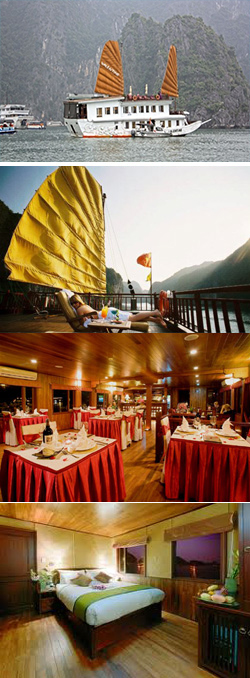
A complete package of emerald water, picturesque beauty and adventurous mountains, Halong Bay is a worth visiting place in Vietnam. Its beauty sparks up your imagination within no time. If you are planning to travel around Vietnam and especially Halong Bay, then you must take the prestigious services of the special Valentine Cruise.
Halong Valentine Cruise


Although the cruise is small, yet it provides all those services which are provided by the bigger boats of Halong Bay. It is a small package of cabins, decks, lounges and rooms for the tourists who come from faraway corners of the world to visit Halong Bay. There are total 5 cabins in the boat, but are wonderfully decorated and excellently accommodating. One will definitely find this cruise very amazing and excellently managed by the crew of the cruise.

Hanoi & Halong Bay 4 days


It has a Suite Cabin, well equipped bathrooms, showers, and other important facilities in it. Once you will experience travelling in it, you will find it exclusive, intimate and very much private because of the service it renders to its clients. If you are planning to travel around the Halong Bay, then you must book one of the cabins of the beautiful Valentine Cruise. I am sure you will recommend it to others after your experience as well.


Cruise Itinerary:

Like all other cruises, Valentine Cruise offers day and night packages to the visitors. There are two days and three days packages as well in which the cruise takes you to the explicitly beautiful surrounding areas of the Halong Bay including all the floating villages, caves, islands and mountains as well.

At first, you will pass through the excellent Bai Tu Long Bay which takes you to the Halong Bay. You will be served with excellent lunch during your trip. The cruise will then take you to the Luon Cave, which is one of the most breathtaking places around the Halong Bay. The cruise will show you the Head Island, Turtle Island, Heaven’s Gate Island. You can explore the caves by kayaking as well.

Next destination will be the Ti Top Island where you can spend considerable time in swimming and enjoying with your loved ones. The Cruise also takes you to the Surprise Cave area of the Halong Bay the next day. Hence, all the important and worth watching places will be visited by you once you book in the Valentine Cruise. The dinner, lunch and other accommodations are carefully handled by the crew.

Who will enjoy:

As the name suggests, the Valentine Cruise is perfect for couples who are newly married. As the cruise is small and cannot accommodate much people in it; therefore, only love birds can enjoy in it. The romantic, quiet water and spell bounding sceneries add a lot to the most romantic experience of your life.

Thứ Tư, 26 tháng 11, 2014

Luon cave Halong Bay

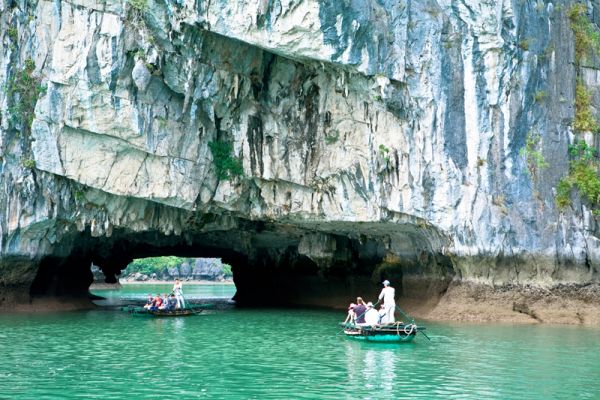
Luon cave is located in the northeast of Bo Hon Island and more than 1km away from Sung Sot Cave. This is one of the most famous places in Halong Bay to travelers in recent years. In front of the grotto is Con Rua Islet, and the Sky Gate is on the right. Here the cliffs stretch vertically out of the pure blue and smooth water. Everything painted an amazing vivid picture.

If you love kayaking, you shouldn’t miss Luon Cave because of the round lake with emerald water hiding inside the cave. The lake is surrounded by luxuriant trees and high dangerous limestone walls. Thus, you can only get inside the cave via a natural gate with a lot of beautiful stalactites on the ceilings. That is also the reason why local people call this place as Luon Cave (means Tunnel Cave). The gate has 4-meter-wide, 100-meter-long, and about from 2.5 to 4-meter-high depending on the tide level. Looking at the arched entrance, you can easily realize that weathering process still occur here, water still drop off slowly from the stone.

3 best places for kayaking in Halong Bay


 After passing the pretty gate, you will see great scenery with cycads, ferns and benjamin’s fig trees shade the landscape and many orchids hang their sweet-scented flowers. If you're lucky, you will have chance to contemplate and take pictures of beautiful golden monkeys jigging up and down on the trees around the cliffs. Of courses, they are so lovely and friendly with tourists. Below the calm emerald water’s surface in lake, there is a vibrant life of many species like shrimp, fish, crab and cuttlefish, etc.
Luon cave Halong Bay

The size of mouth’s grotto isn’t enough for cruising. However, you can either reach easily the cave’ inside by kayak or by small boats rowed by local people and need to spend about 20 minutes for return route. You will be instructed to wear life jackets according to the provisions of Management’s Ha Long Bay in order to ensure tourist’s safety.

Luon Cave (Tunnel Cave) possesses beautiful scenery, great values of geology and paleontology so that we can do sightseeing or research, etc. It’s hard to find anywhere else in Ha Long Bay being as amazing as Luon cave which is the mingling of a number of factors: the mountain’s size and form, the color of the water and the clouds.